Ces exercices art et pouvoir te font décrire et interpréter des œuvres, des photos et des séries, puis défendre ton point de vue sur le rôle politique de l’art. La difficulté monte du vocabulaire jusqu’à un court essai.
À retenir : L’art peut servir le pouvoir par la propaganda, les portraits officiels ou les affiches de guerre, ou le défier comme contre-pouvoir (a counter-power) par la satire et l’art de protestation. Pour s’entraîner sur « Art et pouvoir » en Première, la fiche propose 21 exercices progressifs : associer les mots, compléter avec le bon mot et servir ou défier le pouvoir. Le corrigé détaillé est sur une page séparée ; fiche gratuite, à imprimer en PDF.
Cette fiche d’exercices est à télécharger en PDF et à imprimer gratuitement : le bouton se trouve en bas de la page, sans inscription.
Les exercices
Exercices art et pouvoir : décrire, comprendre, argumenter
Exercice 1 : associer les motsAssocie chaque mot anglais à sa traduction (a à h).
- a cartoonist
- a caption
- to mock
- to commission
- a watchdog
- censorship
- ruthless
- to unveil
a. la censure – b. impitoyable – c. un dessinateur de presse – d. dévoiler – e. une légende – f. un chien de garde – g. se moquer de – h. commander (une œuvre)
Complète avec : propaganda, protest, portrait, exaggerates, photograph, series.
- During the war, posters were used as ___ to recruit soldiers.
- “Strange Fruit” is one of the most famous ___ songs.
- The official ___ of the President was unveiled in 2018.
- A cartoonist often ___ the features of politicians.
- Nick Ut’s ___ changed the way people saw the war.
- House of Cards is a ___ about a ruthless politician.
Exercices 3 à 4
Exercice 3 : servir ou défier le pouvoir ?Dis si chaque œuvre sert le pouvoir (Serve) ou le défie (Challenge).
- A royal portrait of Elizabeth I with her hand on a globe.
- Billie Holiday’s song about lynchings.
- The “I Want You” poster with Uncle Sam.
- Gillray’s cartoon of George III as a greedy king.
- An anonymous stencil against mass surveillance.
- A statue of a general ordered by the government after a victory.
Lis le témoignage imaginaire d’une photographe de presse puis réponds en anglais.
I have covered protests on three continents. People often think my job is about taking beautiful pictures. It isn’t. It’s about being there when nobody else is, and showing what those in power would prefer to hide. Once, my camera was confiscated by soldiers; another time, a government accused me of faking an image. I never retouch my photos, apart from light and contrast, because one fake picture can destroy the credibility of a whole profession. The hardest question is not technical, it’s ethical: when someone is suffering, should I help or should I shoot? Usually I do both. A picture can travel around the world in minutes, but I still believe that it can only change things if people take the time to look at it.
- According to the photographer, what is her job really about?
- Give two examples of pressure she has faced.
- Why does she never retouch her photos?
- What is “the hardest question” for her?
- What does “shoot” mean in this context?
- What condition does she give for a picture to change things?
Exercices 5 à 6
Exercice 5 : décrire un dessin de presseObserve le dessin schématique puis réponds en anglais.
- Who or what is sitting on the left?
- What is he sitting on? Why is it significant?
- Describe the character on the right.
- What does the giant pencil symbolise?
- Explain the irony of the caption.
Complète le résumé avec : ruthless, schemes, heir, breaks, cynical, greed.
- The main character of House of Cards is a ___ politician.
- He ___ against his rivals to become President.
- He often ___ the fourth wall to talk to the viewer.
- The series gives a very ___ vision of politics.
- In Succession, each child wants to be the ___ of the media empire.
- The family is destroyed by ___ and ambition.
Exercices 7 à 8
Exercice 7 : situer dans une imageComplète avec : in the foreground, in the background, on the left, on the right, in the middle, at the top.
- ___ of the poster, in big letters, we can read “I WANT YOU”.
- ___, very close to us, a girl is running towards the camera.
- ___, far away, we can see black smoke.
- ___ of the picture, exactly at the centre, stands the queen.
- ___, on the side where the text begins, there is a soldier.
- ___, opposite the soldier, a mother holds her child.
Chaque phrase contient une erreur. Recopie-la correctement.
- The poster is a propaganda.
- The caricaturist of the newspaper drew the President as a baby.
- The actual Prime Minister was mocked in the series.
- The government censured the photo and banned it.
- I watched two serieses about power last month.
- This painting was commissioned from the king in 1588.
Exercices 9 à 10
Exercice 9 : traduire en anglaisTraduis ces phrases en anglais.
- Les dessinateurs de presse se moquent des dirigeants.
- Cette chanson a été interdite à la radio.
- L’art peut donner une voix à ceux qu’on n’entend pas.
- La photo a changé l’opinion publique sur la guerre.
- Le portrait officiel a été dévoilé en 2018.
- Cette série donne une vision cynique du pouvoir.
Traduis ces phrases en français.
- The press is often called the Fourth Estate.
- The statue was pulled down by protesters.
- Satire exposes the hypocrisy of the powerful.
- The artist chose to remain anonymous.
- Viewers become the accomplices of the main character.
Exercice 11
Exercice 11 : production guidéeRédige un essai de 150 à 180 mots : Can art be a real counter-power?
- Introduction : définis le contre-pouvoir et annonce ta problématique.
- Montre avec deux exemples que l’art peut défier le pouvoir.
- Montre ses limites (censure, récupération, art au service du pouvoir).
- Conclus en donnant ton avis.
- Réutilise au moins cinq mots du cours.
Écris le nom formé à partir de chaque verbe.
- to rule → a ___ (la personne)
- to sculpt → a ___ (la personne)
- to censor → ___ (l’action)
- to protest → a ___ (la personne)
- to rebel → ___ (l’action)
- to oppress → ___ (l’action)
- to depict → a ___ (l’image)
- to resist → ___ (l’action)
Transforme chaque phrase à la voix passive.
- The king commissioned a portrait.
- The artists painted the mural in 2019.
- The government banned the film.
- Someone unveiled the statue in 1890.
- The newspapers will publish the cartoon.
- The police have removed the poster.

Lis la plaque. Réponds aux questions par des phrases complètes en anglais.
- When was the statue erected?
- Who paid for it?
- True or false? The statue was always in the town.
- For how many years was the statue away from the town?
- Why do you think it was removed? Give your opinion in one sentence.
La propaganda sert à glorifier le pouvoir ou à faire obéir. La satire utilise l’humour pour critiquer le pouvoir. Classe chaque œuvre.
- A poster shows a leader as a giant hero protecting small, happy citizens.
- A cartoon shows a mayor with a huge nose, sleeping during a meeting.
- A film shows a dictator as a ridiculous man who cannot stop falling over.
- A song praises the king as the best ruler in history and forbids all other songs.
- A magazine cover shows politicians as puppets pulled by strings.
- A mural shows smiling soldiers and the words "Our nation is perfect".
Complète avec must, might ou can’t.
- The leader is painted much taller than everyone else. He ___ want to look powerful.
- The portrait has no name on it. It ___ be by a famous painter, but we don’t know.
- This statue is only five years old. It ___ be from the nineteenth century.
- The painting is full of gold and jewels. The king ___ be very rich.
- The poster is torn and dirty. It ___ be new.
- Nobody knows who painted the mural. It ___ be a local student.
Lis l’article, puis réponds aux questions en anglais.
Lena, a street artist, painted a huge mural on the wall of a school. It shows a tree with roots that look like hands. At first, the mayor asked her to remove it because he thought it was too political. But hundreds of pupils signed a petition. In the end, the town council decided to let the mural stay. "Art belongs to everyone," Lena said.
- What did Lena paint?
- Where did she paint it?
- Why did the mayor want it removed?
- What did the pupils do?
- What was the final decision?
- Which sentence shows Lena’s opinion?

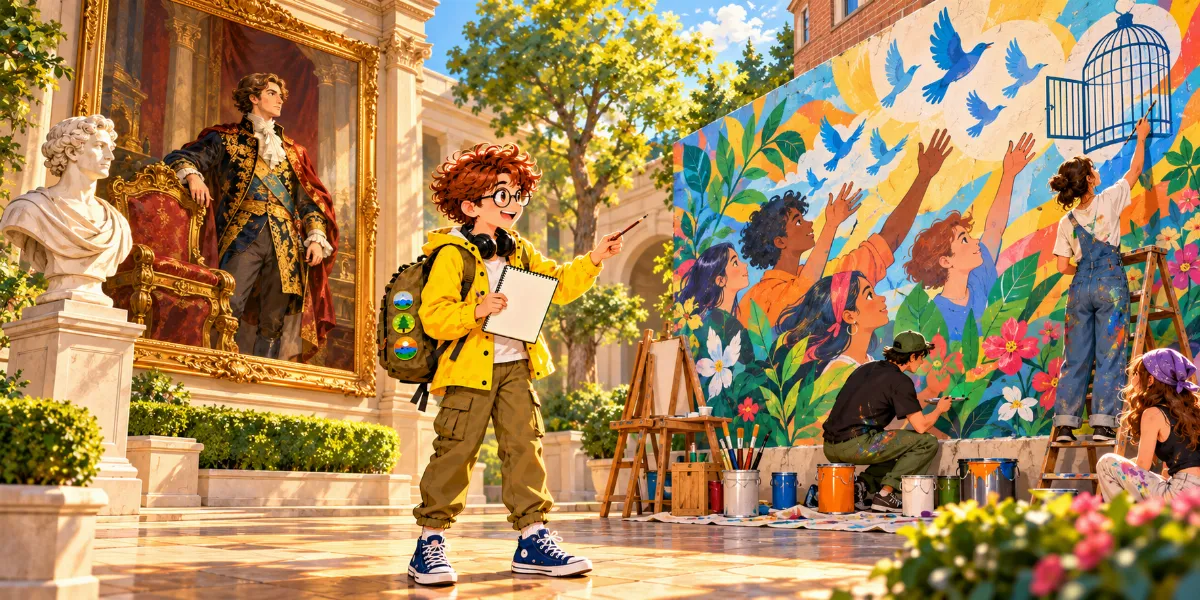
Observe la fresque et complète l’analyse.
- In the centre, I can see ___.
- The bird is breaking ___.
- The main colours are ___.
- The chain symbolises ___.
- The bird represents ___.
- The message of the mural is that ___.
Complète avec les expressions de la liste : In my opinion, I strongly believe, On the other hand, Some people argue, I partly agree, That is why (ou that is why).
- ___ that art must always obey the government, but I disagree.
- ___ that artists should be free to express their ideas.
- ___, art can shock people.
- ___ with the idea that artists must respect others.
- ___, free art makes a society stronger.
- Artists help us to think, ___ we must protect their freedom.
Sujet : Can art be used by those in power, and can it be used against them? Rédige un paragraphe de 10 à 12 lignes avec deux exemples (une œuvre qui sert le pouvoir, une œuvre qui le critique), des connecteurs et ton opinion.